
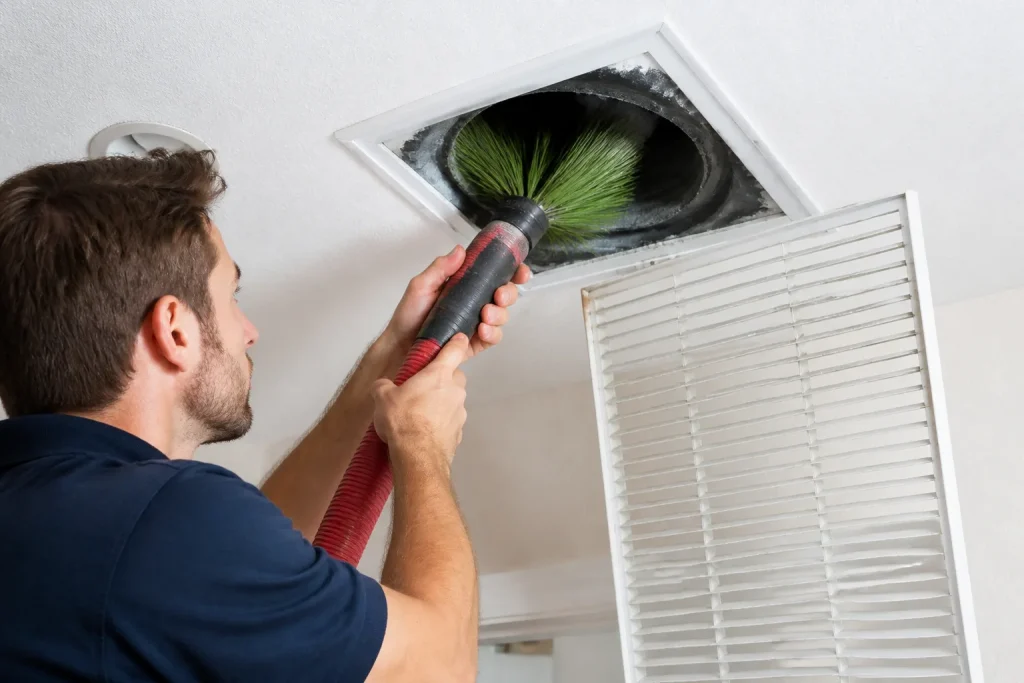
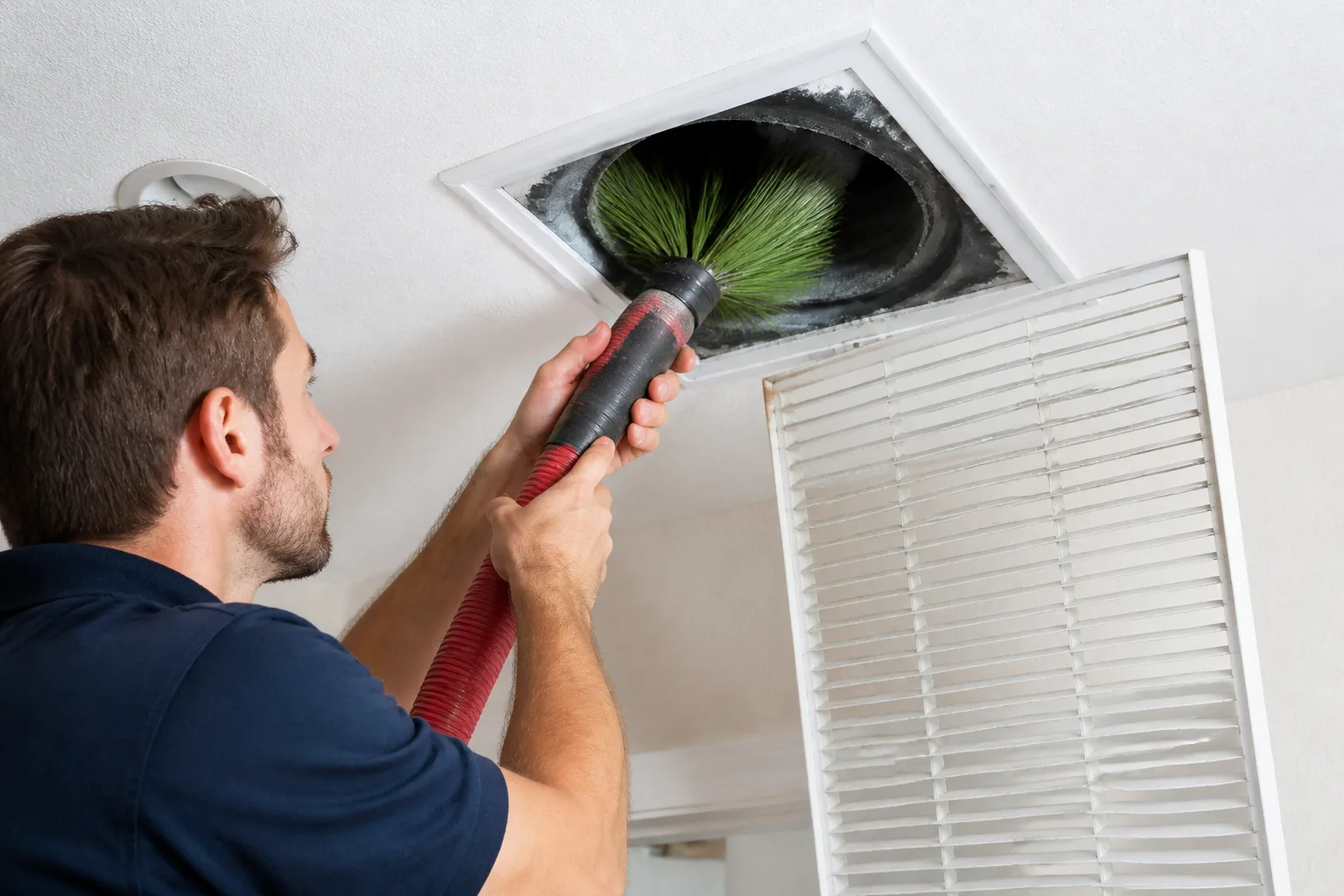
Top Signs You Need Air Duct Cleaning Service – Don’t Ignore These
Dust settling on your furniture isn’t a reliable sign your ducts are dirty. It’s usually a sign your filter isn’t capturing what’s already circulating in the room. The indicators that actually matter live at the return grill and in how fast your filter loads up. In this guide, we’ll walk through the process-based signals we look for when we assess a home in Soundview, so you can read your own system instead of guessing.
If you’d rather have someone look at it than crawl around with a flashlight, call (844) 630-1582 for a free estimate.
Key Takeaways
- Filter loading rate tells you more about duct debris than any visual impression of your vents.
- Dust streaks at supply registers point to internal contamination, not a dirty grill face.
- Matted growth at the return grill is a different problem from ordinary dust and needs sanitizing, not just vacuuming.
- Allergy symptoms that track your HVAC run cycles matter more than the calendar.
- Renovation work deposits specific debris types that standard filtration doesn’t catch.
How do I read my filter’s loading rate as a diagnostic?
Your filter’s loading rate is the clearest early indicator of duct debris load, and it’s simple to track. Note the date you install a filter and the date it looks visibly loaded. Compare that span to the filter’s rated lifespan. A filter that clogs well ahead of its rating is telling you something specific: either return air is bypassing the filter frame, or the ducts are delivering more particulate to the filter face than the filter was designed to handle.
Here’s how we break down what a fast-loading filter usually means:
- Clogs in a fraction of its rated life: high debris load in the return path, often from a system that hasn’t been cleaned in a long stretch.
- Clogs fast but the filter face looks patchy: air is slipping around the filter rather than through it, which means unfiltered air is reaching your blower and coil.
- Filter stays clean far longer than expected: sometimes a sign of a duct leak or disconnected run pulling air from a crawlspace or wall cavity instead of the living space.
- Filter loads evenly but the house still feels dusty: particulate is entering downstream of the filter, which points to supply-side contamination.
That last pattern is common in Soundview homes where the return plenum has never been sealed. When we run air duct cleaning assessments, we check the filter frame and the return connection before we touch anything else. A filter that’s doing its job but still losing the battle is a system problem, not a filter problem.
What does the dust pattern at my supply registers tell me?
Dust streaks radiating from a supply register indicate contamination inside the duct, not a dirty grill face. If you wipe the grill and the streaks return within days, the source is upstream. Surface-level grill buildup wipes off and stays off for weeks. Internal contamination keeps feeding the streak from the duct interior every time the blower runs.
Look for these specific patterns at your supply registers in Soundview:
- Dark streaking radiating outward from the louver slots. Air is carrying particulate out of the duct and depositing it at the boundary where airflow slows.
- Uniform gray film across the whole grill. More likely ordinary room dust settling on a horizontal surface than duct debris.
- Streaks on some registers but not others. Airflow asymmetry. The streaking runs are carrying more debris, which often means a restriction or a poorly balanced branch.
- Fine white or gray powder at the register edge. Drywall particulate or insulation fiber, common after renovation and worth a closer look.
Airflow asymmetry is the pattern most homeowners miss. When one room’s register streaks and the one across the hall doesn’t, the system isn’t moving air evenly, and the loaded run is usually the one with the contamination. Our technicians have up to 8 years of experience reading these patterns, and the visible sign at the grill is usually just the surface of what a proper inspection shows.
What should I look for at the return air grill?
A visual inspection at the return air grill separates two very different problems: ordinary dust accumulation and matted biological growth. Ordinary dust is dry, loose, and gray. Matted growth is darker, holds moisture, and clumps together. That second pattern means the system has been running with elevated humidity or organic material in the airstream, and it calls for sanitizing rather than a vacuum pass.
At the return grill, check for:
- Dry, loose dust coating the grill face. This is normal and filter-related, not a duct emergency.
- Dark, clumped, or matted deposits. This is growth, and it needs a different response.
- Musty or stale odor when the blower kicks on. Odor that appears only with airflow is coming from the duct interior.
- Visible debris on the return plenum walls. Anything you can see at the plenum tells you the duct behind it is carrying more.
When we find matted growth, we don’t just vacuum it. We use Abatement Technologies air-purification equipment for the sanitizing stage, which is remediation-grade equipment built for real air-quality work rather than surface cleaning. Clean ducts are step one in Soundview. What happens after the cleaning is what keeps them clean.
Why do allergy symptoms that follow my HVAC cycles matter more than the calendar?
Allergy symptoms that spike when your HVAC cycles on are a more reliable trigger for duct cleaning than any fixed interval. Calendar-based cleaning is guesswork; symptom timing tied to airflow is evidence. If you feel worse within an hour of the system starting and better when it’s off, the airstream is delivering something your body reacts to.
Here’s how to tell the difference between a seasonal reaction and a system reaction:
- System-driven: symptoms worsen indoors when the blower runs, ease when it’s off, and stay consistent across seasons.
- Seasonal: symptoms track pollen counts and outdoor conditions, not your thermostat schedule.
- Room-specific: symptoms cluster in one or two rooms, which points to a single loaded branch or a leak pulling from a cavity.
We’ve seen this pattern repeatedly in Soundview homes where the ductwork was never sealed after installation. The reaction isn’t the house being dusty. It’s the system moving particulate into specific rooms on a predictable schedule. That’s a diagnostic, not a feeling, and it’s what we use to prioritize where we clean first.
What’s on the post-renovation checklist for duct debris?
After renovation work, your ducts collect specific debris types that standard filtration doesn’t reliably catch. Drywall particulate is the big one: fine gypsum dust that travels deep into the duct runs and settles. Insulation fibers are the second, and they’re a different problem entirely because they lodge in the duct lining rather than moving with airflow. If you’ve had any drywall work, sanding, or insulation replacement done, your ducts need a genuine inspection, not a filter swap.
The checklist we use after renovation in Soundview:
- Drywall particulate: fine, white-to-gray powder that coats duct interior surfaces and the blower wheel.
- Insulation fiber: visible strands, especially in older duct lining. Different cleanup approach than drywall dust.
- Construction dust in the return plenum: the accumulation point before the filter, which is where the heavy load lands first.
- Dryer vent contamination: renovation activity often disturbs the dryer vent run, and lint buildup is a leading cause of residential fires. A standard HVAC-only company will miss this. We cover it in the same visit as part of our dryer vent cleaning work.
- HVAC coil condition: construction dust settles on the coil, which cuts efficiency and pressures the system. We evaluate this during the HVAC cleaning stage.
One thing worth knowing: a post-renovation cleaning and a seasonal filter change are not the same job, even when they look similar from the outside. We use Rotobrush and Nikro equipment, the same systems professionals rely on in commercial buildings, because construction particulate is exactly the kind of load that needs professional-grade contact agitation and vacuum.
When should I call a pro instead of checking myself?
Call a professional when the signs are systemic rather than cosmetic. A filter that loads fast, a supply register that streaks within days, matted growth at the return, or symptoms that track your HVAC run cycles all point to a duct problem rather than a surface dust problem. Those are the cases where a filter change and a wipe-down won’t fix anything, and where waiting usually means the blower, coil, and duct lining all take more wear.
Here’s the rule we give homeowners: if two or more of the signs in this guide show up together, it’s time for a proper assessment. And after any significant renovation, it’s worth a look regardless of what you’re seeing, because drywall particulate and insulation fiber often hide where you can’t see them.
We assess the whole duct pathway, not just the individual runs. Duct repair and sealing is a named part of our work, which means we identify and fix compromised ductwork rather than cleaning around it. We also handle air-quality upgrades after cleaning with Honeywell and Aprilaire solutions and Guardsman-branded products in our cleaning and protection protocols, so the improvement lasts. Better air starts with understanding what’s moving through your ducts, and the assessment is where that starts.
Related services in Soundview: full air duct cleaning, dryer vent cleaning, and HVAC cleaning are all handled by the same team, so you’re not coordinating multiple contractors.
The Bottom Line
The signs that actually indicate you need duct cleaning are observable and process-based: a filter loading faster than its rating, dust streaks returning to supply registers within days, matted growth at the return grill, symptoms that follow your HVAC cycles, and renovation debris that your filter can’t catch. Vague feelings that the air “seems off” are the least useful signal. Specific patterns are what point to real contamination.
If you’re in Soundview and want to know what your system is actually doing, Air Duct Cleaning Soundview offers free estimates. We answer 24/7, and fast dispatch runs from 7am to 7pm, Sunday through Friday. Call (844) 630-1582.
Frequently Asked Questions
There’s no fixed interval that applies to every home. Evidence-based triggers are more reliable than a calendar: filter loading faster than its rated lifespan, recurring dust streaks at supply registers, matted growth at the return grill, symptoms tied to HVAC cycles, or recent renovation work. If none of those apply, you probably don’t need it yet. Call (844) 630-1582 for an exact assessment. Estimates are free.
Cost depends on the system size, number of runs, and condition of the ductwork. We set one flat price per system that’s agreed before work starts, so there’s no per-vent pricing and no surprise invoice after the technician arrives. Call (844) 630-1582 for a free estimate and a written price. The written estimate sets the final number.
Cheap quotes usually price a surface pass, not a full-system clean. The low number gets you in the door, and the invoice grows once the technician sees the actual condition. We give one flat price per system upfront, agreed before any work begins, and we show before-and-after photos of your own ducts so you know what was actually done. Call (844) 630-1582 for an honest estimate.
Before-and-after photos of your ducts, taken during your job. Every cleaning gets them, so you can see the interior condition rather than take it on trust. If a contractor can’t show you the ducts before and after, ask why. Call (844) 630-1582 to book a free estimate.
Written by the team at Air Duct Cleaning Soundview.
Need Air Duct Cleaning Help?
Call Air Duct Cleaning Soundview - the local pro we connect you with is licensed and insured, here with fast help in Soundview.
(844) 630-1582